

Buyer guide with Colleen Olivas
Pre-Approval vs. Pre-Qualification: What's the Difference?
By Colleen Olivas, NMLS #379721, The Brandon Drew Group, a division of New American Funding Last reviewed October 2026
Quick answer
A pre-qualification is a quick estimate, often based on information you tell the lender and the lender has not checked. A pre-approval is a deeper look: the lender verifies your income, jobs, savings, debts and credit. Neither one is a promise to lend. Many sellers and listing agents give more weight to the verified one.

Key points
- Pre-qualification is a quick estimate. It is often based on information you give the lender that has not been checked.
- Pre-approval is a deeper review. The lender looks at documents that verify your income, employment, assets, debts and credit history.
- Neither is a guaranteed offer of a loan. The Consumer Financial Protection Bureau (CFPB) says so plainly, and so do we.
- A verified pre-approval tells a seller that someone has already looked at your paperwork. That is why many listing agents ask for one with an offer.
- A pre-approval can fall apart after it is issued if your job, debts, credit, savings or the home itself change. Telling your lender early about any change gives you the most room to fix it.
On this page (12 sections)
Why this question matters when you start looking
You find a home you like. You call the listing agent, or your own agent does. The first thing anyone asks is, "Are you pre-approved?" If you have only been pre-qualified, you may find out that is not quite the same thing.
This is one of the most common questions we hear from buyers in Rancho Cucamonga and across the Inland Empire. The two words sound alike. Lenders, websites and apps sometimes use them in different ways. So a buyer can think they are ready when the seller does not see it that way.
The National Association of Realtors reports in its 2025 Profile of Home Buyers and Sellers (released November 2025) that first-time buyers made up a record low 21% of buyers. Many people are buying a home for the first time without a family member who has done it before, so knowing what a lender and a seller look at can take some of the guesswork out of the first call.
This guide explains the difference in plain words. It covers what a real pre-approval checks, why sellers and listing agents pay attention to it, what can go wrong after you have the letter, and what to ask any lender before you trust their paperwork. We are a mortgage branch, so we have a stake in this. We will try to keep the advice useful even if you choose someone else.
What is pre-qualification? What is pre-approval?
Pre-qualification is an early estimate of what a lender may be willing to lend you. It usually starts with a short conversation or an online form. You say what you earn, what you owe and what you have saved. The lender may run a quick look at your credit, or it may not. The result is a rough range.
Pre-approval is a closer review. The lender collects documents and checks that what you said is true. Then it tells you, in a letter, the amount and type of loan it is generally willing to offer, based on what it found. The lender then has a real file to work from.
The CFPB says both terms refer to a letter from a lender that says the lender is generally willing to lend to you. They are not guaranteed loan offers. The CFPB also says the words a lender uses do not tell you much about that lender's process. In practice, many lenders base a pre-qualification on what you tell them and a pre-approval on documents they check. That is a common pattern, not a rule, which is why the best question is always "what did you verify?"
What people get wrong
Myth: "Pre-qualified and pre-approved mean the same thing."
What's true: Not always. The words sound alike, and different lenders use them differently. Ask what was checked. That tells you more than the label does.
Myth: "A letter means the loan is done."
What's true: It does not. A pre-approval is a starting point. The loan still has to go through full underwriting, and the home still has to meet the loan's property requirements, which usually includes an appraisal.
Myth: "Getting pre-approved hurts my credit a lot."
What's true: Checking credit is part of the process, and it can have an effect. We don't pull your credit on a first call; it's pulled at application, with your permission. If you talk to more than one lender, FICO treats multiple mortgage inquiries within a shopping window as a single inquiry. The window is 45 days on newer FICO versions and 14 days on older ones, and the lender's scoring version decides (source: myFICO).
Myth: "I can do it later, after I find a home."
What's true: You can, but in a busy market, waiting means you lose time at the moment time matters most.
Pre-approval vs. pre-qualification: side by side
This table is a general guide. Individual lenders vary, so ask each one what their own letter means.
Pre-qualification
- What is it?A quick estimate of what you may be able to borrow
- What is it based on?Often what you tell the lender, which may be unverified
- Is credit looked at?Sometimes, sometimes not
- Do you give documents?Often no
- Is it a promise to lend?No
- How much do sellers rely on it?Usually less
- How long does it take?Often quick
- Best used forGetting a first idea, early planning
Pre-approval
- What is it?A review of your documents, with a letter from the lender
- What is it based on?Documents the lender has checked
- Is credit looked at?Usually yes, with your permission
- Do you give documents?Yes: pay records, tax returns, bank statements and more
- Is it a promise to lend?No
- How much do sellers rely on it?Usually more
- How long does it take?Depends on how fast you send documents and on the lender
- Best used forMaking an offer on a home
Source for the definitions: Consumer Financial Protection Bureau (consumerfinance.gov). The "how sellers weigh it" row reflects how the process generally works, not a measured statistic.
What a real pre-approval verifies
The CFPB says a lender has to document and verify five things when it makes a mortgage: your income, your employment, your assets, your debts and your credit history. A real pre-approval starts that work early. Here is what each one means and what we usually ask to see.
Income
What you earn and whether it is likely to continue
Documents lenders commonly ask for: Pay stubs, W-2s, tax returns; for self-employed buyers, more business records
Employment
That you work where you say, and for how long
Documents lenders commonly ask for: Employer names and dates; sometimes a call or written verification
Assets
Money for your down payment, closing costs and, when required, reserves (savings left after closing)
Documents lenders commonly ask for: Bank and savings statements; records for any gift funds
Debts
What you owe each month
Documents lenders commonly ask for: Credit report, plus statements for loans and cards
Credit history
How you have handled credit
Documents lenders commonly ask for: A credit report, pulled with your written permission
Source: Consumer Financial Protection Bureau, loan options (consumerfinance.gov/owning-a-home/loan-options/), as of October 2026. The "documents" column is our general practice and varies by loan type and by borrower.
Income
The lender wants to know how much you make and whether it will continue. A steady paycheck is simple. Bonuses, overtime, commissions, rental income and self-employment income are counted too, but the lender often looks at a longer history and asks for more records. If your income comes from a mix of sources, tell us at the start. We explain what each source needs.
Employment
Lenders confirm that you work where you say you do. They also look at how long you have been in your field. A recent job change is not always a problem, but it is a fact the lender will want to understand. Under Fannie Mae's rules, lenders review the most recent two years of work history. Other loan types have their own rules, and an individual lender, including New American Funding, can ask for more.
Assets
Your assets show that you can pay the cash needed to close and, in many cases, that you have something left over. The lender looks at where the money is and where it came from. A sudden large deposit with no explanation is the kind of thing that raises questions. Under Fannie Mae's rules, a large deposit is a single deposit of more than half of your total monthly qualifying income. A lender can set a stricter rule, so keep your statements and tell us before you move money.
Debts
Your monthly debts are part of what decides how much you can borrow. Lenders compare them with your income. That comparison is called debt-to-income ratio, or DTI. Our guide on debt-to-income ratio explains how it works.
Credit history
Your credit report shows how you have handled loans and cards. Lenders look at late payments, balances, collections and the length of your history. We tell you what we see, in plain words, and what, if anything, could be worked on before you make offers.
What Inland Empire sellers and listing agents want to see
The Inland Empire is a big region, and each city and price range has its own feel. We will not claim to know how every seller thinks. We will describe how the process usually works, and your real estate agent can tell you how offers are being read where you want to buy.
Here is what a seller wants to know when an offer comes in:
- Will this buyer be able to close? That is the first question. A seller who takes a home off the market wants the sale to actually finish.
- Has anyone looked at the buyer's paperwork? A verified pre-approval tells the seller that a lender has checked the buyer's income, assets and credit. A pre-qualification built on unverified answers tells them much less.
- Is the lender real, and will it answer the phone? Listing agents often know which lenders are reliable. A letter from a lender whose name they trust can matter, so working with a lender who answers calls is part of your offer. We cannot speak for any particular listing agent. We can only tell you what we try to make true on our side.
- Does the letter match the offer? A letter for an amount far below the offer price, or for a different loan type than the offer assumes, can make a seller hesitate. We write letters that fit the offer you are making.
- Is the buyer's deposit safe and clear? Sellers also look at the earnest money deposit, which is the good-faith money a buyer puts into escrow. See our guide on earnest money in California.
None of this is a rule. Some sellers weigh price and terms above everything else. Some care about the closing date or about the buyer's willingness to adjust. A verified pre-approval does not win an offer by itself. It does take a question off the table, which can help when other offers are close on price.
Pre-approval is also not a favor to the seller alone. It helps you. You learn what you can afford before you fall in love with a home, and you find problems when you still have time to fix them.
The underwriter's-eye view: what Colleen checks up front
An underwriter is the person who reviews a loan file and decides whether the loan meets the rules. Colleen started in that job. Her habit is to look at a file the way the underwriter will, so that a pre-approval is an honest preview and not a surprise waiting to happen. For more on this, see what underwriters look for.
Here are the things she looks at first.
- Does the income on paper match the income in real life? She checks that pay stubs, tax returns and bank deposits tell the same story. Differences are not always a problem, but they need an explanation early.
- Is the employment history clear? Gaps, job changes and new self-employment all have a story. She asks for it before the underwriter has to.
- Where did the savings come from? She looks for recent large deposits, transfers between accounts and gift funds. Each one needs a paper trail. Under Fannie Mae's rules, a gift needs a signed gift letter that states the amount and that no repayment is expected, and the donor must be a relative or have a family-type relationship, never someone tied to the builder, developer or real estate agent. Other loan types have their own rules.
- What is on the credit report, and is it correct? Errors do exist. If something looks wrong, it is better to start fixing it now.
- How do the monthly debts compare with income? See debt-to-income ratio.
- Does the loan type fit the buyer? A buyer who could use a different program should hear about it before they make an offer.
- What could change between now and closing? This question is the most useful. We talk through it with you: job plans, big purchases, savings, and anything else that moves.
A pre-approval is more useful when a person has reviewed your documents. The test is simple. Did a person look at your documents, or did a form return a number?
What can make a pre-approval fall apart
A pre-approval is based on what was true when the lender looked. If something important changes, the lender may have to take a new look. These are the usual causes. Most of them are avoidable.
A new job or a change in pay
Your income and employment were verified as they were
What to do: Call us before you accept or leave a job
A new loan, card or large purchase
It changes your monthly debts and your credit
What to do: Wait until after closing, or ask us first
A drop in your credit
The pre-approval relied on the credit report we saw
What to do: Pay on time; do not close old accounts without asking
Money moved or large deposits
Assets must be documented and sourced
What to do: Keep statements; tell us before moving money
The home does not meet the loan's property requirements, such as the appraisal
The property has to meet loan requirements, too
What to do: Ask your agent and us how the appraisal works
The home has a condition problem or title issue
The property is part of the approval
What to do: Ask for inspection and title advice early
Missing or late documents
The lender cannot finish the review
What to do: Send what we ask for as soon as you can
A change in the loan rules
Guidelines are updated from time to time
What to do: Ask us about any recent changes
Notice that the home is part of this list. A pre-approval says something about you. A loan approval also depends on the property. The appraisal is one way the lender checks that the home supports the loan. For the full picture of how the whole file is reviewed, see what underwriters look for.
Do and don't while you shop
Taken from the advice in this guide.
Do
- Call us before you accept or leave a job.
- Keep your statements, and tell us before you move money.
- Pay on time.
- Send what we ask for as soon as you can.
Don't
- Take on a new loan, card or large purchase before closing without asking us first.
- Close old accounts without asking.
- Make large deposits you can't explain.
- Shop above your letter without a call first.
How long a pre-approval letter stays useful
Every letter is dated, and a pre-approval is a snapshot. Lenders usually set a period during which they consider it current, and they can ask for updated documents when it passes. Our team usually treats a letter as current for about 90 days, and then updates it with fresh documents. That is our usual practice, not a promise that any letter stays valid for 90 days, because it depends on the lender, the loan type and your own file.
What you can count on in general:
- The letter ages. The older it gets, the more the lender may want to refresh your pay stubs, statements and credit. As one example of a general rule, Fannie Mae says credit documents can be no more than four months old on the note date, which is the date you sign the loan. A lender can set a stricter rule.
- Life moves faster than paper. If you change jobs, take on debt or move savings during your search, call us. An updated letter is better than an old one that no longer matches your file.
- Searching longer is fine. Many buyers look for months. We usually update your letter with fresh documents after about 90 days.
- A letter is for a specific amount and loan type. If you decide to look in a different price range, we can reissue it.
Step by step: how to get a pre-approval that holds
- 1Start with a no-pressure conversation. Tell us about your income, savings, debts and goals. Pre-qualification is fine as a first step. Just do not stop there if you plan to make offers.
- 2Gather your documents. Typical items are recent pay records, tax returns, bank and savings statements, a government photo ID and information about debts. Your list may be shorter or longer, depending on your situation.
- 3Give permission to check your credit. We don't pull your credit on a first call. It's pulled at application, with your permission.
- 4Let us review the file like an underwriter. Colleen checks the items above. We tell you what we see, including anything that could cause trouble.
- 5Choose a loan type and a price range together. The letter should fit the way you will actually shop. Ask whether any program you might use, such as down payment assistance, changes the rules. Sellers and their agents also want the letter to match the type of loan in the offer.
- 6Get the letter, and ask what could change it. Ask for the list in plain words. Keep it nearby.
- 7Keep your finances steady while you shop. Avoid new debt, big purchases and unexplained deposits. Tell us about any change.
- 8Send us each offer before you submit it. We can adjust the letter or answer a listing agent's questions.
- 9Stay in touch through closing. The pre-approval is the start. See our guide, Buying your first home in Rancho Cucamonga, for the rest of the road.
Common mistakes
Stopping at pre-qualification
An estimate is a good place to start. It is not a good place to make an offer from. If a lender cannot tell you what they verified, ask for a fuller review before you shop.
Collecting letters from many lenders without a plan
Comparing lenders is smart. Doing it carelessly can add confusion. Decide what you want to compare: how the lender communicates, what they explain, what the loan costs, and what they say could go wrong. Then compare those things. If you do compare lenders, try to do it within a short stretch of time, because FICO treats multiple mortgage inquiries within a shopping window as one (see the credit section above).
Shopping above your letter
Falling for a home that costs more than your letter supports is easy. Do not let a listing change your plan without a call first.
Changing your finances after the letter
The most common cause of trouble is the one we cover above: a new car, a new card, a new job or a large deposit. Please wait, or call us first.
Treating the letter like a budget
Being pre-approved for an amount does not mean that amount is comfortable for you. Think about your life, not only the maximum. We will talk through what feels right for your household, your savings and your goals.
Questions to ask any lender
You can bring this list to any lender, including us.
- Is this a pre-qualification or a pre-approval? Ask them to say what the difference is at their company.
- What did you verify? Income, employment, assets, debts and credit are the five things to ask about.
- Did a person review my documents? Or did software return a number?
- What would change this letter? A good lender gives you a short, plain list.
- How long is the letter current, and what do you need to update it? Ask for the specifics at their company.
- Who will I talk to when I have a question? Names and a direct number, not only a ticket system.
- Will you speak with the listing agent if needed? Some offers need a quick call.
- What does the loan cost, and what are the terms? Ask for it in writing, on a Loan Estimate, the standard form lenders must give after you apply. We do not quote rates or payments on this page.
- Which loan types and programs can you offer me? A lender who has one product has one answer.
- Will the same people handle my file from start to finish? See how we work.
If a lender cannot answer these plainly, keep asking.
The bottom line
Pre-qualification is a quick look. Pre-approval is a careful one. Neither is a promise to lend, and both can change if your life or the home changes. A verified pre-approval gives you clarity and gives the seller something real to read. It helps you decide before you fall in love with a house.
If you are not sure which one you have, ask your lender what was verified. If something in your file needs work, it is better to learn that now than after a seller accepts your offer.
Start early, send your documents, tell us what changes, and ask us what could go wrong. We will give you straight answers, including the answer "not yet."
Your next step
Talk it through with Colleen
A short call helps you know what to ask and what to have ready. No pressure.
 Free guide · PDF · California editionThe Homebuyer's Guide
Pre-approval, CalHFA, GSFA and the other down payment programs, in plain words. Read it at your own pace.
Download the free guide
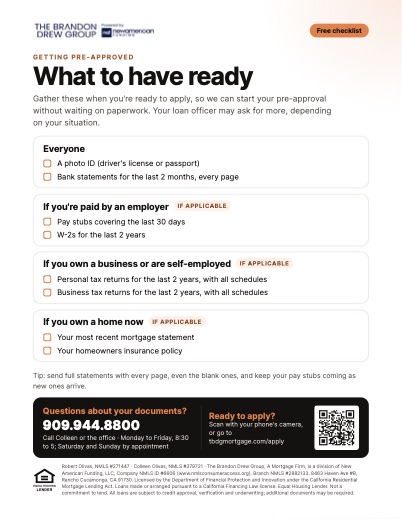 Free checklist · PDF · one pageWhat to have ready
The documents to gather when you're ready to apply, so we can start your pre-approval without waiting on paperwork.
Download the checklist
Questions buyers ask
What is the difference between pre-approval and pre-qualification?
Pre-qualification is a quick estimate of what a lender may be willing to lend, often based on information you provide that has not been checked. Pre-approval is a deeper review in which the lender verifies your income, employment, assets, debts and credit history, then gives you a letter. The Consumer Financial Protection Bureau says neither is a guaranteed loan offer, and that the words a lender uses do not tell you much about its process. So ask what was verified.
Do sellers accept a pre-qualification letter?
Some may, but many listing agents prefer a pre-approval, because it shows a lender has checked the buyer's paperwork. We cannot speak for any particular seller or agent. Your real estate agent can tell you what the listing agent expects for the home you want. If you only have a pre-qualification, ask us for a fuller review before you make an offer, so you are not scrambling when it matters.
→ Read: How we work
What documents do I need for a pre-approval?
Lenders must document and verify income, employment, assets, debts and credit history. In practice, that usually means recent pay records, tax returns, bank and savings statements, identification and information about debts. Self-employed buyers and buyers with several income sources often need more. If you receive gift money from a relative, tell us early, because gifts need their own paperwork. We email you a "needs list" that fits your situation.
→ Read: What underwriters look for
Can a pre-approval be taken back?
A pre-approval is not a promise to lend, so yes, it can change. If your job, income, debts, credit or savings change, the lender may need to review your file again. The home matters too, because the property has to meet the loan's requirements. Telling your lender early about any change is the best way to protect your letter. A lender should tell you in plain words what would make it take a new look.
→ Read: What underwriters look for
How long does a pre-approval last?
It depends on the lender, the loan type and your file. Letters are dated, and lenders usually ask for updated documents after a period of time. Our team usually treats a letter as current for about 90 days, then updates it with fresh documents. That is how we usually work, not a promise that a letter stays valid for 90 days. Ask any lender how long its letter stays current and which documents it will need to update it. The answer can differ from one lender to the next. If your search runs long, ask us to refresh your letter, and tell us about any change in your finances.
Does getting pre-approved hurt my credit?
Checking credit is part of a pre-approval, and it can have an effect. If you compare lenders, FICO treats multiple mortgage inquiries within a shopping window as a single inquiry. The window is 45 days on newer FICO versions and 14 days on older ones, and the lender's scoring version decides. Ask any lender what credit check it plans to run and when. You can review your own reports for errors at AnnualCreditReport.com, the site authorized for the free reports.
→ Read: What underwriters look for
Does a pre-approval mean I have the money for earnest money and closing?
Not on its own. A pre-approval usually includes a look at your savings, but the money still has to be there, and documented, when you close. You need cash for your good-faith deposit, called earnest money, and for closing costs, unless a program you qualify for helps with them. Lenders look at where that cash comes from, so large or unexplained deposits raise questions. Keep your statements and tell us before you move money.
→ Read: Earnest money in California
Does it cost anything to get pre-approved with The Brandon Drew Group?
No. There is no charge for a first conversation or for a pre-approval. You can ask us which fees could come later. After you apply for a loan, you receive a Loan Estimate, the standard form that lists the loan's estimated costs, so you can compare it with other lenders. We are glad to walk through it line by line, with no pressure to move forward.
→ Read: How we work
Sources9 sources · show all
All sources checked October 28, 2026.
- Consumer Financial Protection Bureau (CFPB), What's the difference between a prequalification letter and a preapproval letter: https://www.consumerfinance.gov/ask-cfpb/whats-the-difference-between-a-prequalification-letter-and-a-preapproval-letter-en-127/
- CFPB, Owning a Home, loan options (verification of income, employment, assets, debts and credit history): https://www.consumerfinance.gov/owning-a-home/loan-options/
- CFPB, Loan Estimate: https://www.consumerfinance.gov/owning-a-home/loan-estimate/
- Fannie Mae Selling Guide, B3-6-02, Debt-to-Income Ratios: https://selling-guide.fanniemae.com/sel/b3-6-02/debt-income-ratios
- Fannie Mae Selling Guide, work history (B3-3.2-02, https://selling-guide.fanniemae.com/sel/b3-3.2-02/standards-employment-related-income), large deposits (B3-4.2-02), gift funds (B3-4.3-04) and credit document age (B1-1-03): https://selling-guide.fanniemae.com
- myFICO, how credit inquiries are treated: https://www.myfico.com/credit-education/credit-reports/how-long-do-hard-inquiries-stay-on-your-credit-report
- AnnualCreditReport.com, the official site for free credit reports: https://www.annualcreditreport.com
- National Association of Realtors, 2025 Profile of Home Buyers and Sellers (first-time buyer share): https://www.nar.realtor/press-releases/first-time-home-buyer-share-falls-to-historic-low-of-21-median-age-rises-to-40
- NMLS Consumer Access: https://www.nmlsconsumeraccess.org
Disclosures
Colleen Olivas, NMLS #379721. Robert Olivas, NMLS #271447. The Brandon Drew Group, a division of New American Funding, LLC, Company NMLS ID #6606 (www.nmlsconsumeraccess.org). Branch NMLS #2882133. 8463 Haven Avenue, Suite B, Rancho Cucamonga, CA 91730.
Equal Housing Lender.
Licensed by the Department of Financial Protection and Innovation under the California Residential Mortgage Lending Act. Loans made or arranged pursuant to a California Financing Law license.
This is for information only. It is not a commitment to lend, a pre-approval or a rate quote. A pre-qualification or pre-approval is not a guaranteed offer of credit. Loans are subject to credit approval, verification of information and underwriting, and the property must meet loan requirements. Program terms and guidelines can change without notice. Not tax or legal advice. For licensing information, visit www.nmlsconsumeraccess.org.