

Buyer guide with Colleen Olivas
What Does a Mortgage Underwriter Look For?
By Colleen Olivas, NMLS #379721, The Brandon Drew Group, a division of New American Funding Last reviewed October 2026
Quick answer
A mortgage underwriter checks that you can repay the loan and that the home qualifies for it. They review your income and job, your savings and where the money came from, your monthly debts, your credit history, and the property through an appraisal. Every item must be documented, so the more organized your papers are, the smoother the review tends to go.

Key points
- Underwriting is the step where a person (often after an automated check) decides whether your loan meets the rules. It answers two questions: can you repay, and does the home qualify.
- The lender must document and verify your income, employment, assets, debts and credit history. That is the core of the review, according to the Consumer Financial Protection Bureau (CFPB).
- A "condition" is a request for one more document or an explanation. Getting conditions is normal. Clearing them quickly, with clear answers, is what keeps a file moving.
- Moving money, taking on new debt and changing jobs can all slow a file down. Tell your loan officer before you do any of them, not after.
- Nobody can promise how long underwriting will take. It depends on your documents, the home, the appraisal and the loan program.
On this page (8 sections)
Why underwriting feels like a mystery
Most buyers never meet the underwriter. You talk to a loan officer, you upload documents, and then, later, you get a message: "The underwriter needs one more thing." It can feel like a stranger behind a curtain is changing the rules.
The underwriter is not changing the rules. They apply them. The rules come from the loan program (conventional, FHA, VA, USDA or a state program such as those from CalHFA), from investor guidelines, and from federal law. The underwriter's job is to match your file to those rules and note what is missing.
Colleen worked her way up to underwriter. What she learned is that most surprises are not really surprises. They are questions that could have been answered on day one if the file had been put together with the underwriter in mind. This guide walks through what they look at, what papers they ask for, why they ask, and what you can do to make the process calmer.
No lender can tell you whether you will be approved before seeing your documents. What we can do is explain how the review works so your first conversation is easier.
This guide covers what underwriting is, the five areas reviewed, how conditions work, large deposits and gift funds, job changes, what not to do after you apply, and how we organize a file at the start.
What underwriting is, and where it sits in the process
Underwriting is the review where a lender decides whether to approve a mortgage. The underwriter compares your documented finances and the property against the program's rules. Many lenders first run a file through an automated system. For conventional loans, Fannie Mae's version is called Desktop Underwriter, or DU (Fannie Mae Selling Guide, B3-6-02, checked October 28, 2026). A person then reviews the file and the documents behind it. Fannie Mae's glossary describes DU as "Fannie Mae's automated underwriting system" (Selling Guide glossary, E-3-04, checked November 8, 2026). New American Funding says on its careers page: "We take pride in manually underwriting loans to better serve those with unique financial situations." Ask your loan officer how your own file will be reviewed.
Here is where it sits in the larger journey. Our guide, Buying your first home in Rancho Cucamonga, covers the whole path. In short:
- You talk to a lender and gather documents.
- You get a pre-approval, which is a letter from a lender saying it is generally willing to lend to you. What goes into it depends on the lender. It is not a final approval. See Pre-approval vs pre-qualification.
- You find a home and make an offer. Your earnest money deposit is handled under the terms of your contract. See Earnest money in California.
- You submit a full loan application with the home's address. Then the file goes to processing, where your documents are collected and organized, and then to underwriting.
- The underwriter reviews and either approves, approves with conditions, asks for more, or declines.
- Conditions are cleared, and the loan goes to closing.
Things people get wrong about underwriting:
- "Pre-approval means I'm approved." It does not. The CFPB says both terms refer to a letter from a lender saying it is generally willing to lend to you, that they are not guaranteed loan offers, and that the words used do not tell you much about a particular lender's process (CFPB, checked October 28, 2026). The full review also looks at the home itself, so it comes after you have picked one.
- "The loan officer and the underwriter are the same person." They are not. The loan officer guides you and structures the file. The underwriter is a separate reviewer who checks it against the rules.
- "If I get conditions, something is wrong." Not at all. Conditions are a normal part of underwriting. They are a to-do list, not a verdict.
What does a mortgage underwriter look for?
The CFPB describes the lender's duty plainly: the lender must document and verify your income, employment, assets, debts and credit history to decide whether you can repay. The property matters too, because the home is the collateral. Collateral means the thing that backs the loan. If a borrower cannot repay, the lender relies on the property.
Here is the whole review on one page. Each area is explained below the table.
Source: CFPB, consumerfinance.gov/owning-a-home/loan-options, checked October 28, 2026.
| What they check | What to have ready | What slows it down |
|---|---|---|
| Income and employment: that your income is real, steady and likely to continue | Recent pay stubs, W-2s, tax returns, employer contact details; for self-employed buyers, business records and tax returns | Gaps in work history with no explanation; income that changed recently; missing pages of tax returns; a job change |
| Assets: that you have the funds to close and a source for them | Recent bank and investment statements, all pages; a note on any large deposit; gift letters if a relative is helping | Cut-off or missing pages; large deposits with no paper trail; money moved between accounts without telling us |
| Debts and DTI: your monthly obligations compared with your income | A list of your debts; statements for loans and credit cards; divorce or support documents if they apply | New debt opened during the process; unreported debts that show up on credit; co-signed loans |
| Credit history: how you have handled credit | Authorization to pull credit; letters of explanation for late payments, collections or other marks | Surprises on the credit report; disputes that are open; new inquiries |
| Property and appraisal: that the home qualifies and the value supports the loan | Signed purchase contract; property details; homeowners insurance information; for special programs, the program's property rules | An appraisal that comes in lower than the contract price; repairs the program requires; property issues found during review |
Note: this table is general. Each loan program has its own rules, and your file may need more or fewer items.
Income and employment
What they check. The underwriter wants to know that your income is real, that it is steady, and that it is likely to continue. They are not judging how hard you work. They are looking for proof they can document.
What they ask for and why. The usual starting set is pay stubs, W-2 forms and tax returns. Pay stubs show current income. W-2s and tax returns show the pattern over time. The lender may also confirm your employment directly with your employer, because income is only useful if the job is real. Under Fannie Mae's rules for conventional loans, "the lender must verify the borrower's employment no more than 10 business days on or before the note date" (Selling Guide B3-3.1-04, checked November 8, 2026). The note date is the date you sign your loan note. Fannie Mae also says the most recent paystub "must be dated no earlier than 30 days prior to the initial loan application date" (B3-3.2-01). Other loan types have their own rules, and lenders, including ours, can add stricter rules.
If you are paid hourly, work overtime, earn commissions or bonuses, or have more than one job, expect more questions. Underwriters look at whether this income has been steady, because income that has not yet shown a track record is harder to count. Each loan type has its own rules for how much history it wants, and lenders can add their own, so ask how yours will be counted.
If you are self-employed, expect to share more: business and personal returns, and often a profit and loss statement. Underwriters look at what the business actually earns after expenses, which can differ from what the business brings in. For conventional loans, Fannie Mae "generally requires lenders to obtain a two-year history of the borrower's prior earnings," and says "Any individual who has a 25% or greater ownership interest in a business is considered to be self-employed" (Selling Guide B3-3.5-01, checked November 8, 2026). This is the area where an early conversation helps the most. We will tell you what to gather before you apply.
Common condition: an explanation for a gap in employment or a change in how you are paid. How to clear it: a short, honest, written explanation with any supporting paper, such as an offer letter or a termination notice. Plain and true is best.
Assets, and where the money came from
What they check. Two things. First, that you have enough money for the down payment, closing costs and any reserves the loan needs. Reserves are savings left over after closing. Second, that the money is truly yours or properly given to you. This is called sourcing: showing where the money came from.
What they ask for and why. Bank and investment statements, usually the most recent set, with every page, even blank-looking ones. Missing pages can cause a delay, because the underwriter cannot see what the missing page shows.
Why the focus on sourcing? Lenders must be sure that the funds are not borrowed in a way that hides a new debt, and the loan rules treat different sources of funds differently. Common condition: a letter explaining a deposit, plus the paper that proves it. How to clear it: send the statement for the account the money came from, or the sale or transfer record, along with a short note. Section on large deposits is below.
Debts and your debt-to-income ratio
What they check. Your debts, set against your income. The measure is called debt-to-income ratio, or DTI. In plain words, it is your monthly debt payments, including the future housing payment, divided by your gross monthly income (your income before taxes). It shows how much of your income is already spoken for (Fannie Mae Selling Guide B3-6-02).
We explain this in full in Debt-to-income ratio: what it is and how it is used. The short version is that each loan program has its own limits, and an automated approval can allow different levels than a manual review. For conventional loans, Fannie Mae's rules let its automated system (DU) approve a ratio of up to 50%, while manual underwriting is held to lower limits (Selling Guide B3-6-02, checked October 28, 2026). FHA, VA, USDA and CalHFA programs set their own limits, so see the DTI guide.
What they ask for and why. Your credit report shows most debts. But not all of them. Child support, alimony and some loans not on the credit report may need to be documented separately. Divorce decrees and support orders explain what you owe. If someone else pays a debt for you, such as a family member paying a car loan, the underwriter may ask for proof that they have been making the payments.
Common condition: a statement for a loan that appears on the credit report, or an explanation of a debt you did not list. How to clear it: list every debt honestly at the start. Surprises cost more time than the debt does.
Credit history
What they check. How you have handled credit over time. The underwriter reads the credit report for patterns, not only for a score: on-time payments, how much of your available credit you use, and any collections, judgments or late payments.
What they ask for and why. You will sign an authorization so the lender can pull your credit. If something on the report needs context, the underwriter may ask for a letter of explanation: a short written note. A good one says what happened, why, what has changed, and includes proof if you have it.
Minimum credit scores differ by program and change over time, so we do not list them here. Credit documents also have an age limit: under Fannie Mae's rules for conventional loans, they can be no more than four months old on the note date, which is the date you sign your loan note (Selling Guide B1-1-03, checked October 28, 2026).
Common condition: an explanation for a late payment or collection, or proof that a disputed account is settled. How to clear it: be direct. A true, brief explanation with a document helps. A long one that wanders does not.
The property and the appraisal
What they check. That the home qualifies for the loan, and that it is worth enough to support the amount borrowed. An appraisal is an independent estimate of a home's value, done by a licensed appraiser, usually ordered through the lender. The property must also meet the first mortgage requirements of the program you chose. CalHFA's guides say this for its loans.
What they ask for and why. The signed purchase contract, details about the home, and proof of homeowners insurance. The appraisal arrives after the lender orders it. Some programs add their own property rules. Ask us which ones apply to the loan you are considering.
If the appraisal comes in lower than the price in your contract, you have choices. These can include asking the seller to adjust, bringing more cash, asking the lender to send new information to the appraiser for a second look (often called a reconsideration of value), or reconsidering the purchase. Your real estate agent and your contract matter here, and so does the timing of any contingency in your contract. A contingency is a condition in the contract that lets a buyer step back under set terms. We do not give legal advice, so ask your agent or attorney about yours. For more on how deposits and contracts connect, see Earnest money in California.
Common condition: a repair, a document about the property, or a re-check after the appraisal. How to clear it: let us and your agent handle the property side together, and answer quickly.
Conditions: what they are and how to clear them
After the underwriter reviews your file, a common result is an approval with conditions, sometimes called a conditional approval. It means the loan can move forward if certain items are satisfied. Some conditions are needed before closing. Others are small items for closing day. New American Funding's own blog uses the terms "conditionally approved loan," "prior to documents," "prior to funding," and "final approval" (NAF blog, May 8, 2018, checked November 8, 2026).
Common conditions, and the usual way to clear each:
| Condition | Why it is asked | How to clear it |
|---|---|---|
| Updated pay stub or bank statement | If time has passed, the underwriter may need your newest version. Fannie Mae's rules for conventional loans limit credit documents to four months old on the note date (B1-1-03), and the most recent paystub must be dated no earlier than 30 days before the application date (B3-3.2-01); other loan types differ, and lenders, including ours, can add stricter rules | Send the newest version, every page |
| Letter explaining a deposit | The underwriter must know where the money came from | A short note and the paper that proves it |
| Explanation of a credit item | To understand what happened and whether it will repeat | A brief, true letter with any proof |
| Proof of a debt payment or payoff | To count your debts correctly | The statement or payoff letter |
| Employment verification | To confirm the job is current | Tell us if your job situation changes; we handle the verification |
| Insurance or property item | The home is the collateral | Your insurance agent or the seller's side provides it; we coordinate |
| Gift letter and proof of transfer | To show the money is a true gift, not a loan | See the gift funds section below |
Three habits make conditions easier:
- Answer the same day if you can. Many conditions are small. Answering quickly keeps the file moving.
- Send complete documents. All pages, readable, with your name and the account number visible.
- Ask when you do not understand. We would rather explain a condition twice than have you guess.
Conditions do not mean the underwriter is against you. They mean the underwriter is following a list.
Large deposits and gift funds
Large deposits. Underwriters review your statements for deposits that are not from your regular paycheck. A big deposit that appears out of nowhere raises a fair question: is this your money, or is it a loan? A loan would add to your debts. What counts as "large" depends on the program and the lender. Under Fannie Mae's rules for conventional loans, a large deposit is a single deposit of more than half of your total monthly qualifying income, and, for a purchase, if those funds are needed, "the lender must document that those funds are from an acceptable source" (Selling Guide B3-4.2-02, checked October 28, 2026). Other loan types may use different rules, and lenders, including ours, can add stricter rules.
Common, honest reasons for a large deposit include a sale of a car or other property, a tax refund, a bonus, or moving money between your own accounts. These can usually be documented. What helps: a short note, the statement from the account the money came from, and, for a sale, the bill of sale or record. What hurts: cash deposits with no record, or transfers you cannot explain.
Tip: tell your loan officer before you move savings between accounts. Do not wait for the underwriter to find it.
Gift funds. Fannie Mae's rules for conventional loans allow gift funds from certain donors, with rules. Other programs have their own. In general terms:
- A gift is money you do not have to repay. Under Fannie Mae's rules, the giver signs a gift letter that states the amount (the letter must "specify the actual or the maximum dollar amount of the gift"), that no repayment is expected, and the donor's name, address, telephone number, and relationship to you (Selling Guide B3-4.3-04, checked November 8, 2026).
- The donor must be a relative or have a familial relationship with you. It cannot be anyone tied to the builder, the developer or the real estate agent (B3-4.3-04).
- The underwriter will usually want the money's path documented: out of the giver's account and into yours or into escrow. Lenders, including ours, can add stricter documentation rules than the agency's.
- Not every program allows gifts, and the rules on who can give differ. Ask before you assume.
A made-up example. Suppose "Maria" (a made-up name) has an aunt who wants to help with her down payment. The aunt should not hand Maria a cash envelope. Instead, the aunt writes a gift letter and transfers the money from her account, and Maria keeps the transfer record. That creates the paper trail the underwriter needs to see. This example is for illustration only and is not a real person or a real transaction.
If you are not sure whether something counts as a gift, call us before you take the money.
Job changes and new debt during the process
The underwriter reviews your file at one point in time, but the rules look again before closing. Under Fannie Mae's rules for conventional loans, "the lender must verify the borrower's employment no more than 10 business days on or before the note date" (B3-3.1-04), and if new debts surface before closing, "the lender must recalculate the borrower's debt-to-income ratio" (B3-6-01, checked November 8, 2026). Lenders, including ours, can add stricter rules. That means what you do between application and closing still matters.
Job changes. A new job is not always a problem. Moving to a similar role with similar pay in the same field may be simple to document. A move to a different field, a switch from salary to commission, or becoming self-employed can change how your income is counted. The rule of thumb is simple: tell us before you accept an offer, not after. We can often tell you what the underwriter will want to see.
New debt. A new car loan, a new credit card, or financing furniture changes your debts, and may change your DTI. Even a hard credit check shows up. It can also change what you qualify for. Please wait until after closing for any large purchase. If something is urgent, call us first.
A reminder. None of this is to scare you. Life happens. A buyer who calls us early gets help. A buyer who tells us late may face delays.
What not to do after you apply
A short list. Keep it somewhere handy.
- Do not change jobs or income arrangements without calling us first.
- Do not open new credit or take on new loans, including buy-now-pay-later plans.
- Do not co-sign for anyone.
- Do not make large cash deposits or move money around without telling us and keeping records.
- Do not close or pay off accounts without asking. Sometimes this helps, and sometimes it does not. It depends on your file.
- Do not skip or hide a debt, a mark on your credit, or a past event. The underwriter will probably find it, and honesty is faster.
- Do not ignore requests. A condition left unanswered waits.
- Tell us before you change your name on accounts, your bank, or your insurance.
- Do not make large purchases on credit for the new home until you have closed.
How we structure a file up front
The goal is fewer surprises, found early. Colleen worked her way up to underwriter, and she reviews the files that may be more difficult.
Here is what that looks like.
- We ask for the full picture at the start, including the awkward parts: the job change, the gap, the late payment, the deposit.
- We read the documents before we send them. We look for missing pages, unexplained deposits, and anything an underwriter would ask about.
- We write the explanations ahead of time, so the file arrives with its own answers.
- We choose the loan program with the file in mind. A program that fits the paper is smoother than one that does not.
- Our team prepares each step, and Colleen reviews the files that may be more difficult. That helps avoid surprises.
- We tell you honestly what could slow things down, and we do not promise a timeline.
You can read more about how we work in How we work.
The bottom line
Underwriting is not a hurdle built to trip you. It is a check that your loan fits the rules and that you can repay it. The underwriter looks at five things: your income and job, your assets and their source, your debts, your credit history, and the property. Each one needs paper. Missing pages, unexplained deposits, new debt and late answers can all cause delays.
You can make the process calmer. Gather your documents early. Tell your loan officer about changes before they happen. Answer conditions quickly and honestly. And do not move money, open credit or change jobs without a call.
If you want a second set of eyes, you can bring your documents to the office and we will look at them together before you apply. Or, if you prefer, you can apply online and email or drop off your documents, whatever is comfortable for you. We will give you straight answers, including "not yet."
Your next step
Talk it through with Colleen
A short call helps you know what to ask and what to have ready. No pressure.
 Free guide · PDF · California editionThe Homebuyer's Guide
Pre-approval, CalHFA, GSFA and the other down payment programs, in plain words. Read it at your own pace.
Download the free guide
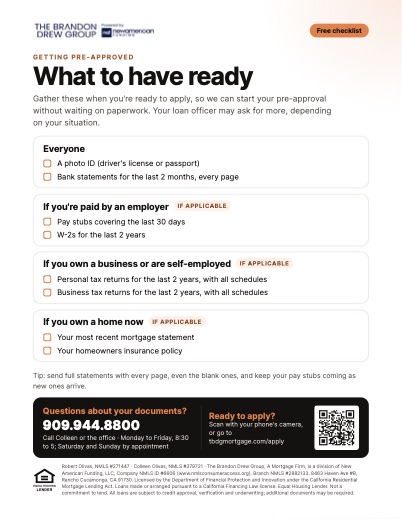 Free checklist · PDF · one pageWhat to have ready
The documents to gather when you're ready to apply, so we can start your pre-approval without waiting on paperwork.
Download the checklist
Questions buyers ask
What does a mortgage underwriter look at first?
There is no single first step; the order can vary by lender and program. Usually your income and whether it is documented and steady come up early, along with your credit report and your debts. The CFPB says the lender must document and verify income, employment, assets, debts and credit history. The underwriter will also look at where your down payment came from. If you are unsure which part of your file is strongest, bring your documents and we will walk through them with you.
What is a condition in underwriting?
A condition is a request from the underwriter for another document, a fuller page, or a written explanation before the loan can close. Conditions are common and do not mean you are being turned down. Examples include a newer pay stub, a letter explaining a deposit, or proof that a debt is paid. The fastest way to clear one is to answer completely and promptly. If a condition confuses you, ask us what it means before you send anything.
Can I use gift money for my down payment?
Often yes, but the rules depend on the loan program, and gifts must be documented. In general terms, the giver signs a letter saying the money is a gift that does not need to be repaid, and the transfer of the money is documented. Under Fannie Mae's rules for conventional loans, the donor must be a relative or have a familial relationship with you, never anyone tied to the builder, developer or real estate agent (B3-4.3-04). Other programs have their own rules. The underwriter will usually want to see the money leave the giver's account and arrive in yours or in escrow. Please do not take cash from a relative before you call us. The paper trail matters.
Will changing jobs stop my loan?
Not always. It depends on the new job, how you are paid, and where you are in the process. A similar job in the same field may be simple to document. A change in pay structure, such as moving to commission, or a move to self-employment, can change how income is counted. Call us before you accept an offer, not after. We cannot promise an outcome, but we can tell you what the underwriter will likely need to see.
→ Read: How we work
Why does the underwriter ask about every deposit?
They need to know the money is yours, or properly given to you, and is not a loan that adds to your debts. A deposit from your regular paycheck is easy to see. A large or unusual one raises a fair question. A short note plus the statement or record that shows the source usually answers it. Tell your loan officer before you move savings between accounts, and keep your statements.
→ Read: How we work
How long does underwriting take?
We cannot promise a timeline. It depends on your documents, how quickly conditions are answered, the property, the appraisal and the loan program. Complete, readable documents and fast answers help. A file with a job change or large deposits that are not yet explained usually takes more back and forth. We tell you what we see as it happens, and we plan backward from your target move date.
What happens if the appraisal comes in low?
Several options may exist: asking the seller to adjust the price, bringing more cash, asking the lender to send new information to the appraiser for a second look (often called a reconsideration of value), or stepping back, depending on your contract. Your agent and your contract matter most here, including any contingency. We do not give legal advice, so ask your agent or attorney about the terms of yours. We can explain how a lower value affects the loan.
→ Read: Earnest money in California
How is working with The Brandon Drew Group different at the underwriting stage?
Colleen worked her way up to underwriter, so when she reviews a file she reads it the way an underwriter will. Our team prepares each step, and Colleen reviews the files that may be more difficult. We explain what could slow things down, and we do not promise a timeline. You can see more about how we handle a file on our how we work page.
→ Read: How we work
Sources18 sources · show all
All sources below were checked October 28, 2026, and November 8, 2026 (Fannie Mae, CalHFA, GSFA and NAF items). Program rules change, so check each page directly.
- Consumer Financial Protection Bureau (CFPB), loan options, and the lender's duty to verify income, employment, assets, debts and credit history: https://www.consumerfinance.gov/owning-a-home/loan-options/
- Consumer Financial Protection Bureau (CFPB), What's the difference between a prequalification letter and a preapproval letter: https://www.consumerfinance.gov/ask-cfpb/whats-the-difference-between-a-prequalification-letter-and-a-preapproval-letter-en-127/
- Consumer Financial Protection Bureau (CFPB), Buying a House: https://www.consumerfinance.gov/owning-a-home/
- Fannie Mae Selling Guide, B3-6-02, Debt-to-Income Ratios: https://selling-guide.fanniemae.com/sel/b3-6-02/debt-income-ratios
- California Housing Finance Agency (CalHFA), program guides and lender matrices: https://www.calhfa.ca.gov
- U.S. Department of Housing and Urban Development (HUD), homebuying information: https://www.hud.gov
- U.S. Department of Veterans Affairs, home loans: https://www.va.gov/housing-assistance/home-loans/
- NMLS Consumer Access: https://www.nmlsconsumeraccess.org
- Fannie Mae Selling Guide, B1-1-03 (credit document age): https://selling-guide.fanniemae.com/sel/b1-1-03/allowable-age-credit-documents-and-federal-income-tax-returns
- Fannie Mae Selling Guide, B3-4.2-02 (large deposits): https://selling-guide.fanniemae.com/sel/b3-4.2-02/depository-accounts
- Fannie Mae Selling Guide, B3-4.3-04 (gifts): https://selling-guide.fanniemae.com/sel/b3-4.3-04/personal-gifts
- Fannie Mae Selling Guide, B3-3.1-04 (employment verification): https://selling-guide.fanniemae.com/sel/b3-3.1-04/verbal-verification-employment
- Fannie Mae Selling Guide, B3-3.2-01 (paystub age): https://selling-guide.fanniemae.com/sel/b3-3.2-01/standards-employment-and-income-documentation
- Fannie Mae Selling Guide, B3-6-01 (new debts before closing): https://selling-guide.fanniemae.com/sel/b3-6-01/general-information-liabilities
- Fannie Mae Selling Guide, B3-3.5-01 (self-employed history): https://selling-guide.fanniemae.com/sel/b3-3.5-01/underwriting-factors-and-documentation-self-employed-borrower
- Fannie Mae Selling Guide, E-3-04 (glossary, DU): https://selling-guide.fanniemae.com/sel/e-3-04/acronyms-and-glossary-defined-terms-d
- New American Funding, why NAF ("manually underwriting"): https://www.newamericanfunding.com/careers/whynaf (checked November 8, 2026)
- New American Funding blog, "The path to final loan approval: know all the conditions," May 8, 2018: https://www.newamericanfunding.com/blog/the-path-to-final-loan-approval-know-all-the-conditions/ (checked November 8, 2026)
Disclosures
Colleen Olivas, NMLS #379721. Robert Olivas, NMLS #271447. The Brandon Drew Group, a division of New American Funding, LLC, Company NMLS ID #6606 (www.nmlsconsumeraccess.org). Branch NMLS #2882133. 8463 Haven Avenue, Suite B, Rancho Cucamonga, CA 91730.
Equal Housing Lender.
Licensed by the Department of Financial Protection and Innovation under the California Residential Mortgage Lending Act. Loans made or arranged pursuant to a California Financing Law license.
This is for information only. It is not a commitment to lend or a rate quote. Underwriting requirements differ by loan program and can change without notice. Loans are subject to credit approval and underwriting. Not tax or legal advice. Examples are made up and for illustration only. For licensing information, visit www.nmlsconsumeraccess.org.